



Twitter Marketing: A Practical Guide for Businesses
Digital MarketingOCT 06, 2026
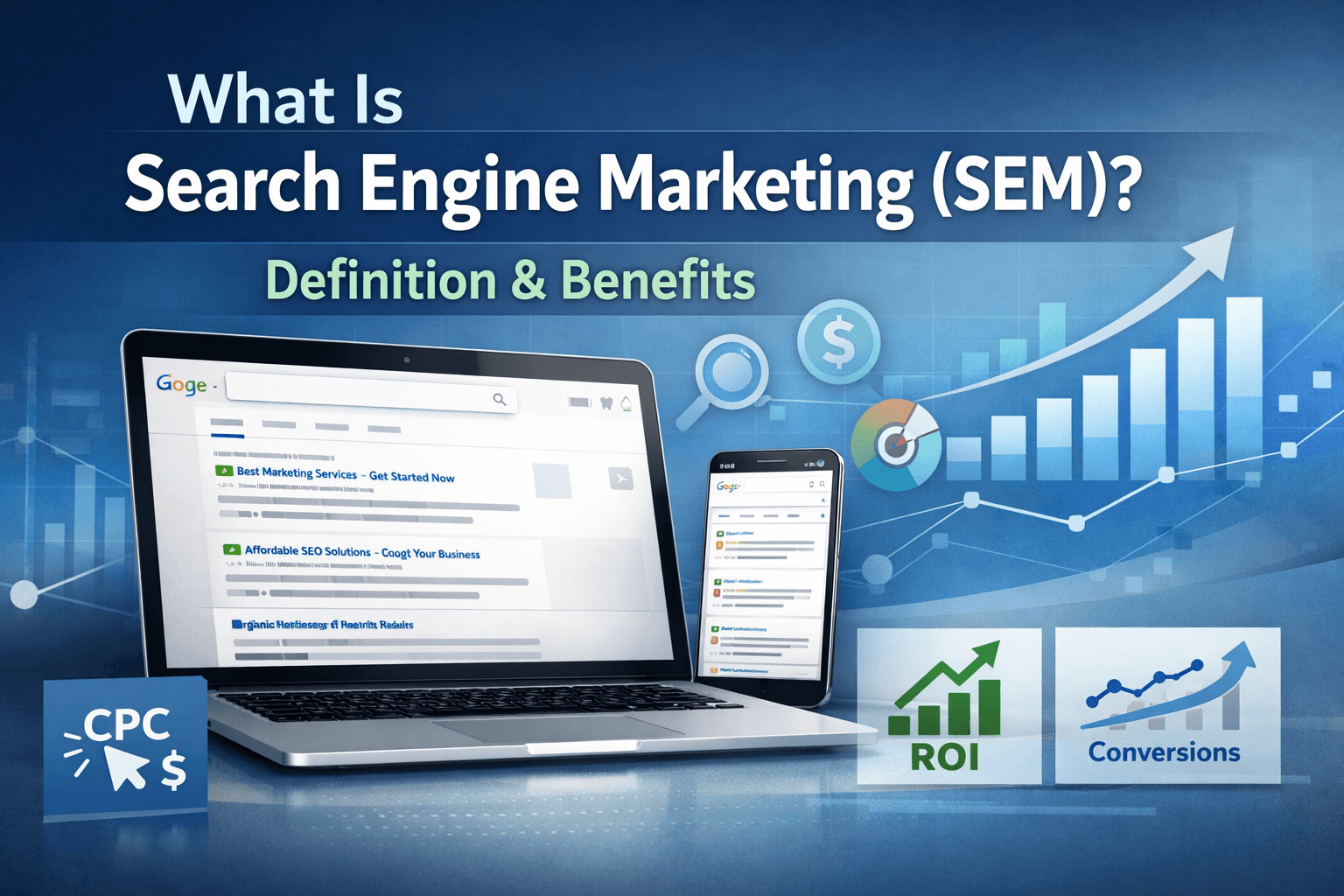
Search engine marketing helps your business appear at the top of search engines when people look for products or services like yours. SEM focuses on paid search, placing ads in front of high-intent users at the exact moment they search.
Search engine marketing, often abbreviated as SEM, is a digital marketing strategy that involves paid search advertising on platforms such as Google Ads and Bing Ads. Advertisers bid on keywords related to their products or services. Their ads appear as sponsored results on search engine results pages (SERPs).
When someone searches for a specific term, the search engine runs an automated ad auction. Ads with strong relevance and competitive bids appear above or below the organic results. You pay only when someone clicks your ad.
SEM follows a structured, data-driven process. Each step impacts performance, cost, and overall campaign success. For a detailed operational guide, refer to the official Google Ads documentation.
The process starts with identifying the search terms your audience uses when looking for your products or services. Focus on high-intent keywords that signal a strong purchase or action intent, for example:
Examples:
Advertisers set maximum bids on selected keywords. This bid represents the most you’re willing to pay per click and directly influences your cost per click (CPC).
Every time someone runs a search, the search engine holds an ad auction that evaluates your bid amount, your ad’s relevance, expected click-through rate, and landing page experience.
Search engines assign a quality score to each keyword based on relevance, historical CTR, and landing page performance. A higher quality score can lower your CPC and improve where your ad places.
Ad rank determines your ad position on the search results page. It combines your bid and quality score, with higher ranks achieving top placements.
After someone clicks your ad, they land on a dedicated page. The pages that convert best match search intent, load quickly, and guide the visitor toward a clear call to action.
SEM depends on continuous tracking. Key metrics include impressions, click-through rate, conversions, and cost per conversion. Reviewing this data lets you refine keywords, ads, bids, and landing pages for better ROI over time.
SEM and SEO both improve online visibility, but they get there through different methods.
| Factor | Search Engine Marketing | Search Engine Optimization |
| Placement | Paid ads | Organic listings |
| Cost | Pay per click | No direct cost per click |
| Speed | Immediate visibility | Gradual results |
| Sustainability | Stops when the budget stops | Long-term impact |
| Control | Full control over targeting | Limited control |
SEO focuses on earning rankings through content, backlinks, and technical optimization. SEM focuses on paid visibility through keyword bidding. Most successful brands run both together: SEO builds long-term authority, while SEM drives fast traffic and conversions in the meantime.
SEM spans several campaign types, each built for a different objective. The most common format is PPC advertising, where advertisers bid on keywords to appear in sponsored search results.
Search Ads are Text-based ads triggered by keyword searches. These ads appear on search engine results pages (SERPs) and are ideal for capturing high-intent traffic ready to take action.
Visual ads shown across the Google Display Network. Display campaigns are effective for brand awareness, reach, and remarketing to users who have previously engaged with your website or content.
Product-focused ads featuring images, prices, and ratings. Commonly used in e-commerce, these ads appear in search results or Google Shopping, driving direct product sales.
Video campaigns reach users through YouTube search results and in-stream placements. Video ads are powerful for brand awareness, storytelling, and consideration-stage engagement.
Remarketing targets people who’ve already visited your site but didn’t convert. Reconnecting with this warm audience typically improves conversion rates and ROI, though it works best paired with conversion rate optimization on the landing pages themselves.
Winning with SEM requires strategic planning and precise execution. Key strategies include:
Focus your budget on keywords that indicate buying intent or specific actions. While these terms may cost more, they typically deliver higher-quality leads and better ROI.
Negative keywords prevent your ads from appearing in irrelevant searches, reducing wasted ad spend and improving click-through rates (CTR).
Regularly test headlines, ad copy, and landing pages. Continuous experimentation helps identify top-performing variations and leads to steady performance improvements.
Ad extensions add visibility and useful information beyond the base ad, including callout extensions, sitelinks, structured snippets, and location or call buttons.
Adjust bids by location, device, time of day, and audience segment to get more out of the same budget.
Align campaigns with different stages of the marketing funnel:
The right tools simplify campaign management and analysis.
Google Ads powers most paid search campaigns. It offers keyword planning, automation, and advanced bidding features.
Google holds the dominant share of global search engine usage, per StatCounter’s market share data, which is a large part of why Google Ads reaches the widest possible pool of searchers. Microsoft Advertising, running on Bing’s network, plays a smaller but meaningful role, particularly for desktop and B2B audiences.
Microsoft Advertising extends reach across Microsoft’s search properties. It often delivers lower CPCs for specific audiences, and advertisers new to the platform can get started with Microsoft’s campaign setup guidelines.
Keyword planners estimate search volume, competition, and bid ranges.
Analytics platforms track traffic, conversions, and user behaviour across campaigns.
Tracking tools connect ad clicks to business outcomes. Accurate tracking supports smarter optimization. Dashboards and reporting tools help visualize performance and guide decisions.
Continuous optimization relies on reviewing performance metrics, understanding user behavior, and adjusting strategy accordingly.
Done well, this process turns search intent into measurable growth while steadily reducing wasted spend.
SEM works especially well for product launches, promotions, and competitive markets where speed matters more than gradual organic growth.
Local Service Business: A plumbing company targets emergency repair keywords. Search ads generate phone calls and inquiries within minutes of campaign launch.
E-Commerce Store: An online retailer uses shopping ads to showcase products. Optimized product listings increase click-through rates and drive sales.
SaaS Company: A software provider targets pricing and demo-related keywords. Paid search campaigns attract qualified leads into the sales pipeline, improving conversion opportunities.
Small businesses benefit from SEM through focused targeting and budget control.
Key approaches include:
Low budgets still work when campaigns focus on high-intent searches and tight geographic areas.
Avoid these issues to protect ad spend.
Fixing these problems improves efficiency and lowers costs.
AI bidding and automation continue to reduce manual campaign work, and smart campaigns are simplifying setup for advertisers at every level. Voice search is starting to influence keyword targeting, while privacy changes are pushing platforms toward cookieless tracking and modeled conversions.
Advertisers who adapt to both automation and privacy shifts tend to hold their performance steady through the transition.
Search engine marketing puts your business directly in front of people actively searching for what you sell. Combined with precise keyword targeting, strong ad copy, and optimized landing pages, it delivers fast and measurable results.
Ready to grow your traffic and conversions? Contact Inoma Digital for expert SEM and SEO support. We can:
📞 Call us: +92-314-2551400
📧 Email: info@inomadigital.com
A digital agency built on systems, clarity, and long-term results. Helping businesses through strategy, design, technology, marketing and business growth.